We asked FraudScore’s CPO, Roman Safonov, a few questions about how 2019 is shaping the ad fraud landscape, forecasts for the near future, and what challenges FraudScore expects to see.
Roman Safonov, FraudScore CPO:
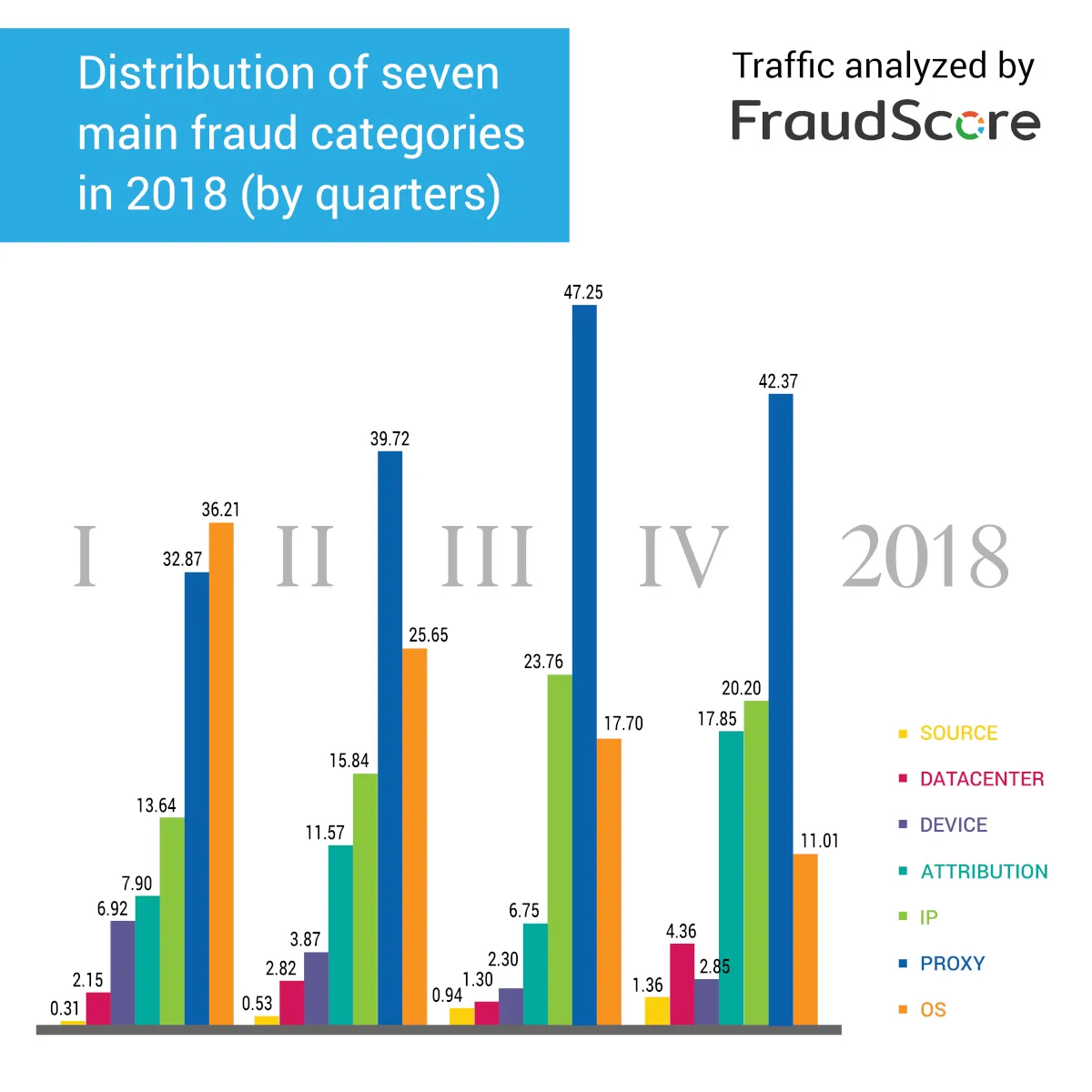
In 2018, 22% of ad traffic that FraudScore analyzed was fraudulent. This affected both mobile and web traffic, resulting in at least $27 billion in losses to marketers. Our forecast at the beginning of 2018 predicted that botnets would dominate, and this was confirmed. While 2017 was the year of attribution fraud, bots continue to grow in sophistication and will persistently evolve.
Trends in 2018
Roman Safonov, FraudScore CPO:
One major trend is the industry’s growing recognition of ad fraud. Global companies like Oracle and Google are addressing the problem, and governments are issuing real penalties. However, this pushes fraudsters to become more tech-savvy—they study campaigns, pay for real offers, and leverage ML and AI to develop sophisticated fraud that’s harder to detect. They even hire developers to create new fraud categories.
Roman Safonov, FraudScore CPO:
Another trend is that fraud detection platforms are no longer just about evaluating “fraud” or “not fraud.” Platforms must provide advanced functionalities, detailed analytics, and reliability, as fraudsters evolve rapidly. Comparing 2017 to 2019, fraud detection tasks have completely changed.
Roman Safonov, FraudScore CPO:
For 2019, we expect botnets and in-app fraud to lead, with OTT fraud growing strongly in the second half of the year. In the first quarter, proxy fraud and IP distribution anomalies were the most common types. Post-install event analysis is also becoming a key method for detecting fraud.
Transparency and Trust
Roman Safonov, FraudScore CPO:
Advertisers, affiliates, and networks are becoming more mature regarding ad fraud detection and prevention. Maturity requires transparency—about fraud scale, source quality, and reasons for conversion rejection. FraudScore acts as a neutral third party, helping companies understand that ad fraud is real but manageable.
FraudScore’s Approach to Transparency
Roman Safonov, FraudScore CPO:
FraudScore stays completely transparent: we detect fraud, categorize it, and explain why traffic is marked fraudulent. Our customers aren’t fraud-detection experts, so we provide detailed, clear, and transparent reports. Fraud detection is not just “fraud or not fraud”; it improves traffic quality and strengthens long-term trust between advertisers and affiliates.
Standardization of Fraud Detection
Roman Safonov, FraudScore CPO:
The most important standard is using ML and AI. Fraudsters are sophisticated and can bypass common detection patterns. Marketers should use solutions with the latest technologies and trial checkups—think of it like vaccination: better to have immunity beforehand than suffer the consequences later.
FraudScore Plans for 2019
Roman Safonov, FraudScore CPO:
Our approach is to cover the entire marketing funnel: prevention, detection, rejection, and post-install/conversion event analysis. We aim to track online ads from RTB requests and impressions to installs and conversions. FraudScore will become a one-stop fraud detection & prevention platform. New post-install/post-conversion event reports will allow deeper CPA analysis, detecting sophisticated fraudsters who emulate real user behavior. We’ll also introduce redirect services to prevent fraudulent clicks and release updated algorithms for attribution fraud and incent detection. Many new integrations are coming. By combining prevention, detection, and long-term control, FraudScore provides a unique solution to cover all campaign risks.